
Beating the Heat: Why New Braunfels Summers Make Your Bins Stink
April 24, 2026
Living in New Braunfels means enjoying the Comal River, backyard BBQs, and that iconic Texas sunshine. But as the thermostat climbs toward triple digits, a less-than-pleasant neighbor usually moves in: the stench from your trash cans.
If you’ve noticed your garage or driveway smelling like a landfill by Tuesday morning, you aren't imagining it. The intense Hill Country heat creates a perfect storm for bacteria. Here’s the science behind why New Braunfels summers are so hard on your bins—and why your garden hose is losing the battle.
The Science of the "Trash Sauna"
When it hits 100°F in Central Texas, the temperature inside a dark plastic trash bin can soar well above 120°F. This creates a literal incubator for disaster.
Living in New Braunfels means enjoying the Comal River, backyard BBQs, and that iconic Texas sunshine. But as the thermostat climbs toward triple digits, a less-than-pleasant neighbor usually moves in: the stench from your trash cans.
If you’ve noticed your garage or driveway smelling like a landfill by Tuesday morning, you aren't imagining it. The intense Hill Country heat creates a perfect storm for bacteria. Here’s the science behind why New Braunfels summers are so hard on your bins—and why your garden hose is losing the battle.
The Science of the "Trash Sauna"
When it hits 100°F in Central Texas, the temperature inside a dark plastic trash bin can soar well above 120°F. This creates a literal incubator for disaster.
- Accelerated Decomposition: Heat catalyzes chemical reactions. In cooler weather, organic waste breaks down slowly. In the Texas heat, food scraps, yard waste, and "hidden" liquids undergo rapid microbial fermentation.
- The Rise of Anaerobic Bacteria: In the cramped, low-oxygen environment of a bin, anaerobic bacteria thrive. These microbes produce foul-smelling byproducts such as hydrogen sulfide (rotten-egg smell) and methane.
- The Humidity Factor: Our proximity to the coast means New Braunfels often deals with high humidity. Moisture is the fuel that bacteria need to multiply, turning your trash into a biological breeding ground.
Beware the "Trash Juice"
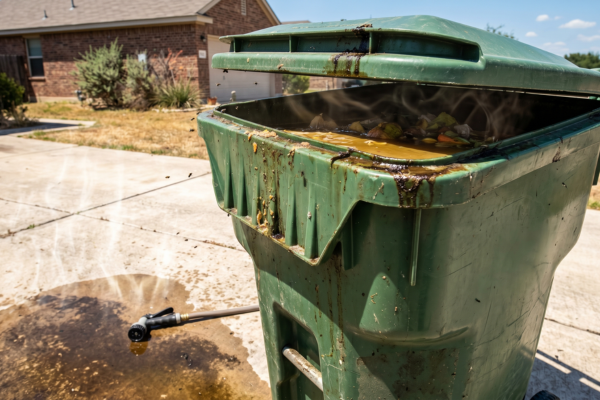
You’ve seen it—that murky, sludge-like liquid pooling at the bottom of your bin. In the industry, we call this leachate, but most homeowners know it simply as "trash juice."
This liquid is a concentrated cocktail of bacteria, mold spores, and decaying organic matter. Because it is acidic, it can actually etch into the plastic of your bin, making the smell nearly impossible to remove with traditional methods. During a New Braunfels summer, this liquid evaporates and recondenses, coating the entire interior of the lid and walls with a thin film of bacteria.
Why a Garden Hose Isn't Enough
Most homeowners try to tackle the problem with a garden hose and some dish soap. While we appreciate the effort, it usually does more harm than good for three reasons:
You’ve seen it—that murky, sludge-like liquid pooling at the bottom of your bin. In the industry, we call this leachate, but most homeowners know it simply as "trash juice."
This liquid is a concentrated cocktail of bacteria, mold spores, and decaying organic matter. Because it is acidic, it can actually etch into the plastic of your bin, making the smell nearly impossible to remove with traditional methods. During a New Braunfels summer, this liquid evaporates and recondenses, coating the entire interior of the lid and walls with a thin film of bacteria.
Why a Garden Hose Isn't Enough
Most homeowners try to tackle the problem with a garden hose and some dish soap. While we appreciate the effort, it usually does more harm than good for three reasons:
- Low Pressure, Low Temp: A standard hose doesn't provide the 200°F+ water temperature required to kill stubborn bacteria and larvae (maggots). It simply moves the grime around.
- Chemical Runoff: Rinsing your bins into the driveway sends "trash juice" and phosphorus-heavy soaps directly into our local storm drains, which eventually lead to our beautiful rivers.
- The "Wet Dog" Effect: If you don't dry the bin completely—which is hard to do given the deep corners—you’re simply providing fresh moisture for the next round of bacterial growth.
The Professional Solution
To truly beat the heat, you need a professional cleaning service that uses high-pressure, high-heat sterilization. Our process eliminates 99.9% of bacteria and captures the wastewater, keeping your home smelling fresh and the New Braunfels environment clean.
To truly beat the heat, you need a professional cleaning service that uses high-pressure, high-heat sterilization. Our process eliminates 99.9% of bacteria and captures the wastewater, keeping your home smelling fresh and the New Braunfels environment clean.
- Pro Tip: Keep your bins in the shade if possible and ensure all bags are tied tightly, but remember: in a Texas July, professional sanitization is the only way to keep the "stink" at bay.
Don't let your driveway smell like a dump this summer. Contact us today for a bin deep-clean!